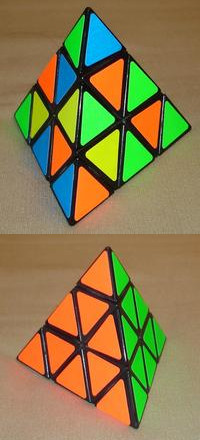
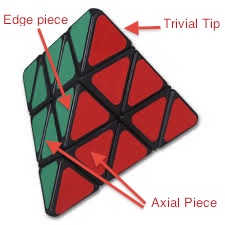
The 4 pieces that make the points of the Pyraminx are called trivial tips. Why?
Because you can rotate these into position without affecting the rest of the Pyraminx! It is literally child’s play. So much so that there is a puzzle called the Tetraminx that is identical to the Pyraminx, but without the trivial tips. Needless to say, it is as difficult to solve as the Pyraminx.
Unlike the 3x3x3 Rubik’s Cube, the Pyraminx does not have a central piece on each face that helps you determine its color.
How then do you determine the color of any face of the Pyraminx?
Look at all the three faces of all three trivial tips of the face that you are interested in. Only one color will show up in all three trivial tips. That is the color of the face.
Now rotate the three axial pieces of that face of the Pyraminx to match the trivial tips and make sure both match the color of the face. Note that both the faces shown in the picture belong to the same axial piece, and rotate together. The axial pieces are three-faced and each of their faces is on a separate face of the Pyraminx.
Now you have only the 3 edge pieces on the face to worry about!
We start with the solution from the position shown at top – with one base completely solved. (Come on, you can get that far by yourself, right?)
After that, you should make sure that you align the axial piece and the trivial tip of the point opposite the base, and make sure that their faces match the correct faces of the Pyraminx (see previous tip). If your Pyraminx ends up solved, congratulations! You’re one lucky gal or dude!
Otherwise, you have the three top edge pieces of which two or three are not correct.
Position the Pyraminx with the point opposite the base pointing towards you and the solved face away from you. The three problematic edges will now be the ones closest to you.
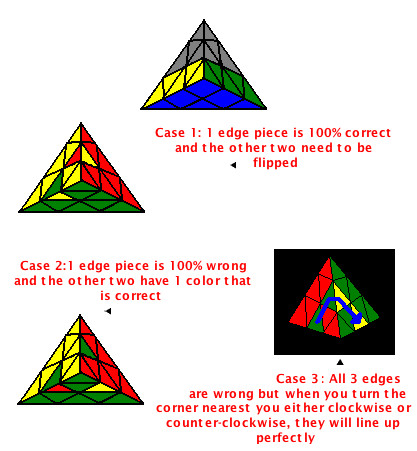
Your Pyraminx will be in one of three configurations shown in the picture. In the case 1 state (double edge flip), two edges are in the correct position but need to be flipped in place (in the picture these are the yellow-red and the yellow-green edge pieces). In the case 2 state (mixed state), one edge is completely wrong (the green-red edge in the figure) and the other two have one face right (yellow for the yellow-green, and red for the yellow-red). In the case 3 state (clockwise or counter-clockwise tricycle), all three edges are wrong, but if you turn the corner once in either direction they will all be right.
Identify which of the three states your Pyraminx is in and proceed to the next page in this section.
If your Pyraminx is in a state similar to Cases 1 and 2 as described in the previous page, do the following: (If it is similar to Case 3, hold your horses! We promise we’ll get to you, and bring along new friends.)
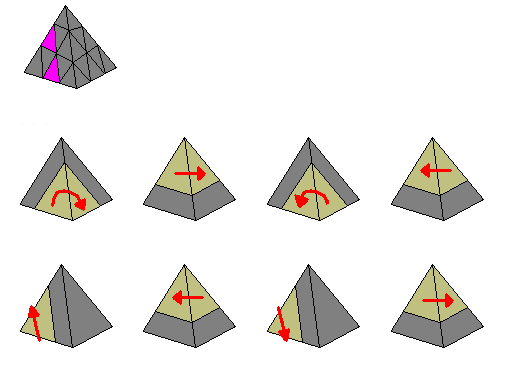
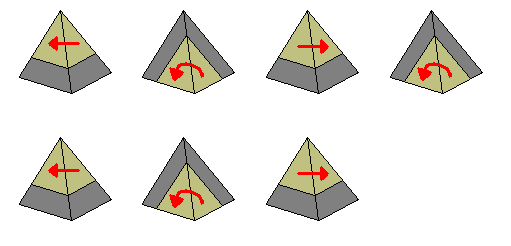
Case 1 (Double edge flip): Hold the Pyraminx so that the two wrong pieces are at the bottom and the left, as shown at the top of the picture. Note that this involves changing the position of the Pyraminx – the solved face will now be on the right side.
Case 2 (Mixed): Hold as above, but with the two partially right pieces at the bottom and left. Again, the solved face should be on the right.
Now carry out the moves shown in the picture.
If your Pyraminx was in the Case 1 state, it will now be solved – Yay! Take a picture. You’re done!
If it was in the Case 2 state, it will now be in the Case 3 state.
See Case 3 people, we told you we’ll bring along new friends!
Go to the next page for the solution.
All Pyraminxes will now be in the Case 3 state (Tricycle), requiring a clockwise or counter-clockwise turn to match up the edges. But if you go ahead and do that, the axial piece and the trivial tip will be on the wrong face, and your previous work will be undone.
So what’s to be done?
Hold the Pyraminx with the solved face away from you and the three wrongly placed edges closest to you. If you needed a clockwise turn to match the edges, follow the top picture.
If you needed a counter-clockwise turn to match the edges, follow the bottom picture.
And you’re all done!
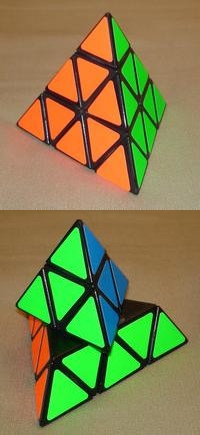
The Pyraminx is a twisty puzzle similar to the Rubik’s Cube. It was invented and patented by Uwe Meffert about the same time as the original 3 layered Rubik's Cube in 1981.
“Twisty” puzzles are three-dimensional puzzles with multiple parts that hold together and yet can be rotated independently to yield extremely large numbers of configurations. They hold an innate fascination for most people and are an important class of mechanical puzzles. We therefore feature this twisty puzzle in the Enigma Café even though twisty puzzles are not well suited to heavy use. Enjoy the fascinating and beautiful Pyraminx, and please be gentle with it.
The Pyraminx is a puzzle in the shape of a tetrahedron, divided into 4 axial pieces, 6 edge pieces, and 4 trivial tips. It can be twisted along its cuts to permute its pieces.
The Pyraminx has 75,582,720 possible positions. However, setting the trivial tips to the right positions reduces the possibilities to less than a million (933,120), making this a rather simple puzzle to solve compared to the Rubik’s Cube which has over 43 billion billion configurations and no such simplifications.
However, this simplicity is only relative – the Pyraminx is still a tough puzzle to solve. As with all twisty puzzles the object is simple – to scramble all the colors and then try to restore the original single colored faces.
Happy twisting!
Uwe Mèffert, the inventor of the Pyraminx, has manufactured and sold mechanical puzzles in the style of Rubik's Cube since the original Cube craze. His first design was the Pyraminx and others include the Megaminx, Skewb and Skewb Diamond. More recently he has licensed and re-released designs from other manufacturers, such as Dogic.
In the 1970s Mèffert created some puzzles for his own amusement using pieces of balsa wood attached to a center ball by rubber bands. He did not think anyone else would be interested in them, and put them away and forgot about them until Ernő Rubik's Rubik's Cube became a worldwide sensation in the 1980s. In 1981 Mèffert took his puzzles to a Japanese toymaker who agreed to market them. One of them, Pyraminx, sold more than 10 million pieces that year, and 90 million within three years. Since that time, Mèffert and his associates have created more than 100 3-D rotating mechanical puzzles.
Mèffert also created his own version of sudoku, the popular nine-number print puzzle. His puzzle consists of nine 3×3 grids, “representing total logic.” One has to place the numerals 1 to 9 in each horizontal and vertical row, each 3×3 box and the two major diagonals without repeating numbers. A “Chinese Magic Square”, consisting of the numbers 1–9, is hidden in a 3×3 grid somewhere in each puzzle. Adding any three numbers together in any direction always adds up to 15, providing additional challenge. Mèffert calls his version of the puzzle KOKONOTSU, a Japanese word meaning simply nine.