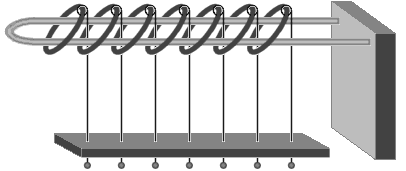
The object is simple:
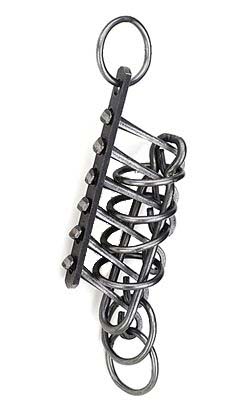
You have to remove the shuttle cleanly off the rest of the puzzle (the rings and nails seen in the picture).
All we have to say is that it takes a lot of patience! You have to carry out a series of precise moves.
It is possible that a visitor before you has left the puzzle in a solved state, with the shuttle completely disentangled from the rings and nails. In this case, your challenge is to return it to its original state, with the shuttle completely tangled in the rings. Specifically, each of the six rings should hang around the shuttle as you can clearly see rings 3-6 doing in the picture.
Unsolving the puzzle is as hard as solving it, and requires the same amount of patience.
Good luck!
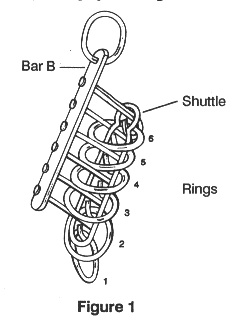
One move will disengage any ring from the shuttle. However, only a ring directly behind the lead ring can become disengaged at one time. Rings 1-5 all become the lead range at some stage in the sequence. Determining the correct sequence is the solution to the puzzle.
The solution to the puzzle is described in the subsequent pages.
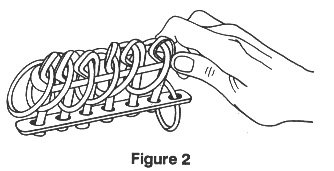
Hold puzzle so that bar B is down, shuttle is on top and nails are pointing up. See figure 2.The basic moves are:
DROP: Move ring to and around the rounded end of shuttle to position flat on top of shuttle. One side at a time, pivot ring through interior of shuttle, toward bar B, to sit under shuttle. The ring is now disengaged.
REPLACE: Reversal of DROP is to re-engage the ring on the shuttle. This is necessary to determine which ring leads.
UNLOCK: The nail on ring 1 must be rotated 180 degrees to face the opposite direction from the other nails. This "unlocks" the puzzle. You are now ready to begin the sequence.
Note: If you make an error in the order of the sequence, the only way to correct it is to put the puzzle back to its starting position and begin again.
SEQUENCE:
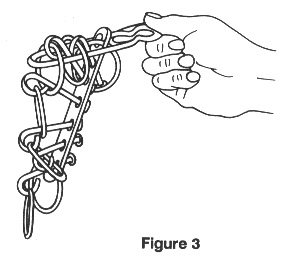
Drop 2, then 1, then 4. Replace 1, then 2. Drop 1, then 3. Replace 1. Drop 2, then 1 (should look like figure 3), then 6.
Replace 1, then 2. Drop 1. Replace 3, then 1. Drop 2, then 1. Replace 4, then 1, then 2. Drop 1, then 3. Replace 1. Drop 1, then 3. Replace 1. Drop2, then 1, then 5.
Replace 1, then 2. Drop 1. Replace 3, then 1. Drop 2, then 1, then 4.
Replace 1, then 2. Drop 1, then3.
Replace 1. Drop 2, then 1.
Shuttle is now free from all rings.
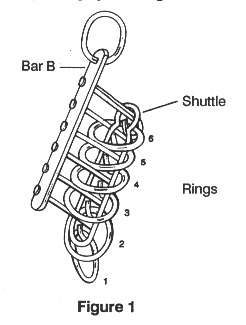
The Patience puzzle is a "take apart" puzzle that is many centuries old and probably came from China. The long looped piece ("the shuttle") at the bottom of the puzzle seems to be hopelessly entangled inside six rings attached to bent nails. When the puzzle is solved, the shuttle is disentangled from the 6 rings and can be cleanly removed from the rest of the puzzle. This puzzle is also called the Chinese rings or the Rings of Cardan.
This is a very difficult puzzle. To solve it, you need to painstakingly carry out many, many steps in the correct order - more that 40 steps for 6 rings. That's why it is called the patience puzzle. Because of its difficulty, it has been put to practical use as a lock.
The sequence of the moves required to solve the Patience puzzle is actually a very important binary code called the Gray Code. This digital code is used in modern electronic equipment for error correction in information transmission and storage. It is amazing that this exquisite mechanical puzzle requires the solution of a digital code to be taken apart.
The Patience Puzzle was provided to MoMath by Tucker-Jones House, and is one of their “Tavern Puzzles.”
Over several centuries the Patience puzzle has appeared in many, many forms and has been the subject of countless patents both in the US and Europe. Noo tanglement set can be considered complete without some form of this puzzle and almost every commercial set includes one. It is still produced today - in metal, wood, and plastic - by everyone from small-volume craftsmen to Asian factories.
It has been known by several names, including The Puzzling Rings, Meleda, The Devil's Needle, Baguenaudier ("Time-Waster" in French), Tiring Irons, Prisoner's Lock, Cardan's Rings (after the famous mathematician Girolamo Cardano who lived from 1501 to 1576 in Italy, who described it in his 1550 book De Subtilitate Rerum, published in Nuremberg), and the Chinese Rings Puzzle - in the orient it was known as the "Delay-Guest Instrument." It has been put to practical use as a lock.
Cardan's Rings was included as number V in Chapter X of Hoffmann's 1893 classic "Puzzles Old and New." Slocum found an advertisement for the puzzle in the 1785 catalogue of Peter Catel in Berlin, where it was called the Nuremberg Trifle. Slocum notes that in Germany it was also known as Zankeisen (quarrel iron) and by using this name it can be traced back to 1541. According to David Darling, the earliest European reference is from about 1500 in problem #107 of De Viribus Quantitatus by Luca Pacioli. According to the Wolfram Mathworld site, Stewart Culin (1858-1929) avers the puzzle was invented by the Chinese general Hung Ming, who lived from 181 to 234 A.D.
Many puzzlers consider this to be among the top puzzles of all time.