(English Game)
Arrange the pegs in a cross shape, keeping the central spot free as shown in the picture
Do not use the 4 fluted holes outside the cross.
A peg can jump over an adjacent peg that has an empty spot on the other side of it. Pegs can only jump horizontally or vertically. Diagonal jumps are not permitted. The peg that was jumped over is removed.
The object of the puzzle is to remove all the pegs except one, which should end up in the central hole.
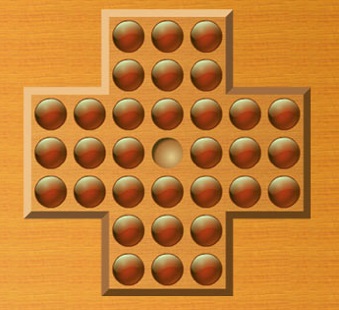
The challenges here will take you to the solution of the English game step by step.
Step 1:
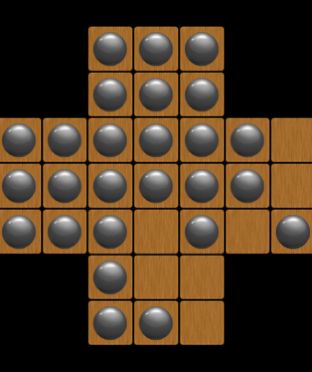
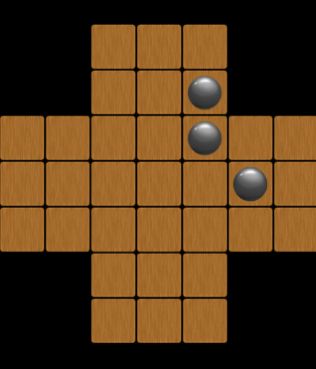
Set up the pegs in the starting position (Pegs arranged in a cross pattern, central hole empty, the four fluted holes not used).
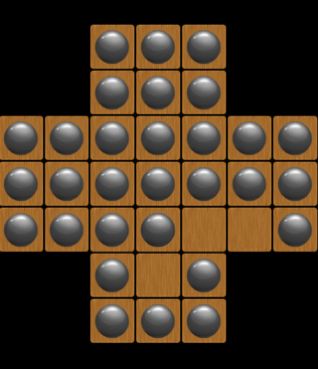
Now, by jumping over some pegs and removing them, try to reach the position shown in the picture.
Step 2:
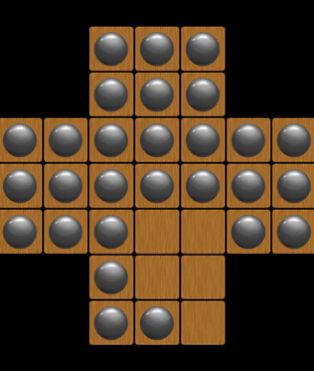
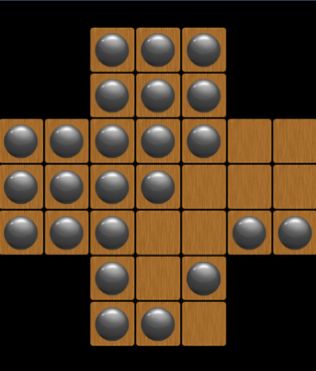
From the position shown at the top (reached in the previous challenge), try to reach the position at the bottom by jumping over some pegs.
Step 3:
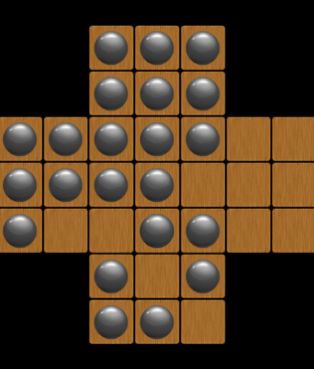
From the position shown at the top (reached in the previous challenge), try to reach the position at the bottom by jumping over some pegs.
Step 4:
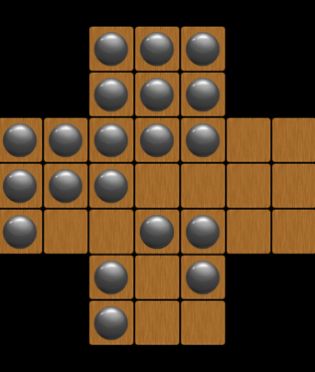
From the position shown at the top (reached in the previous challenge), try to reach the position at the bottom by jumping over some pegs.Step 5:
From the position shown at the top (reached in the previous challenge), try to reach the position at the bottom by jumping over some pegs.Step 6:
From the position shown at the top (reached in the previous challenge), try to reach the position at the bottom by jumping over some pegs.Step 7:
From the position shown at the top (reached in the previous challenge), try to reach the position at the bottom by jumping over some pegs.Step 8:
From the position shown at the top (reached in the previous challenge), try to reach the position at the bottom by jumping over some pegs.Step 9:
From the position shown at the top (reached in the previous challenge), try to reach the position at the bottom by jumping over some pegs.Step 10:
From the position shown at the top (reached in the previous challenge), try to reach the position at the bottom by jumping over some pegs.Step 11:
From the position shown at the top (reached in the previous challenge), try to reach the position at the bottom by jumping over some pegs.Step 12:
From the position shown at the top (reached in the previous challenge), try to reach the position at the bottom by jumping over some pegs.Step 13:
From the position shown at the top (reached in the previous challenge), try to reach the position at the bottom by jumping over some pegs.Step 14:
From the position shown at the top (reached in the previous challenge), try to reach the position at the bottom by jumping over some pegs.Step 15 (Final step)
From the position shown at the top (reached in the previous challenge), try to solve the puzzle by jumping over two pegs and ending with a single peg in the central hole.
Yay, you did it!
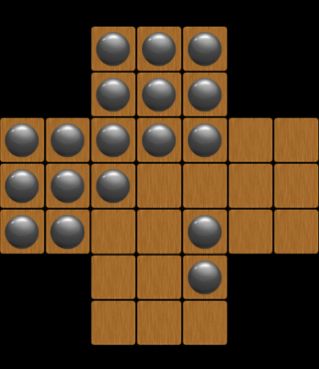
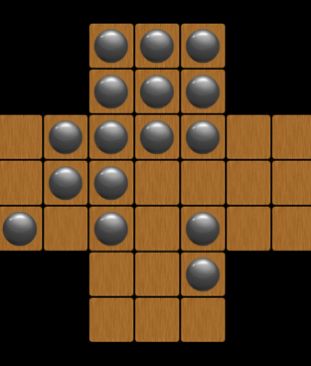
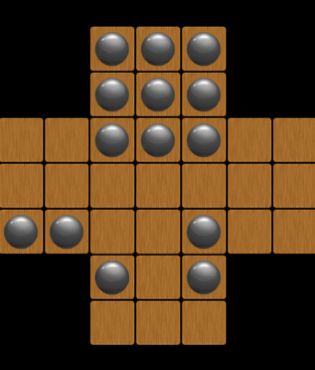
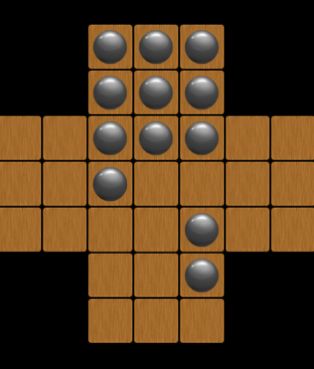
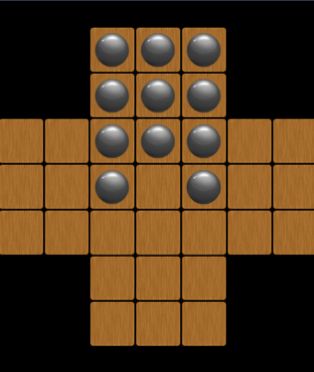
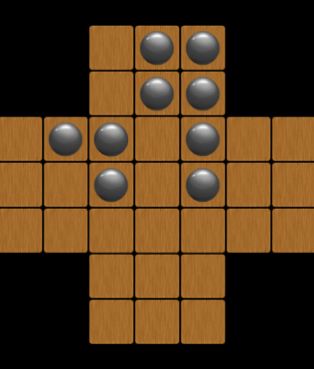
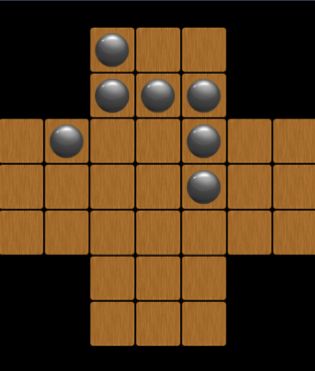
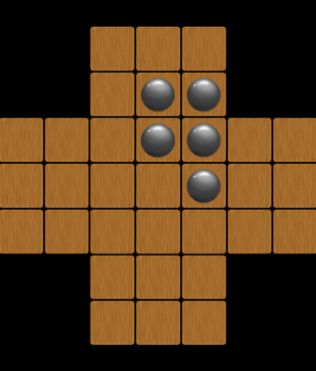
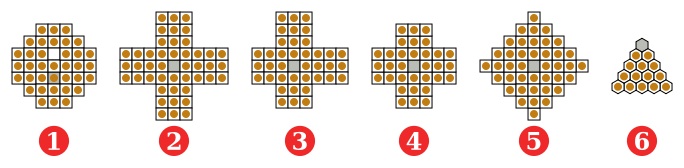
Peg Solitaire is a mathematically rich classic board puzzle, dating from the early 19th century, that involves checkers-like jumping of one peg over another with removal of the peg that was jumped over. There are several different starting configurations of the pegboard as shown in the picture. Each of these can be thought of as a separate puzzle. Initially, the pegs fill the board, except for one empty spot where the first move can be made. The object of the game is to remove all the pegs except for one. Peg Solitaire is a challenging game, as the number of possible moves at any stage can be quite large.
The mathematical concept of parity can be fruitfully applied to many peg solitaire positions and can be used to demonstrate the impossibility of solutions in some configurations. Enjoy playing with the Enigma Café peg solitaire board. Try solving some of the challenges we've presented and try to grasp the very interesting application of parity.